South Carolina Financial Literacy Standards and Policy Ranking

The South Carolina Financial Educators Council (SCFEC) is the state advocacy chapter of the National Financial Educators Council (NFEC). Our role is to advance policy, standards alignment, and statewide action to ensure that South Carolina students graduate prepared to manage real-world financial decisions.

The NFEC conducts national research and develops academic standards. SCFEC translates that research into policy advocacy specific to South Carolina. Our shared mission is to ensure that all learners graduate prepared to navigate real-world financial decisions by elevating financial education to the same level of quality, accountability, and instructional integrity as other required core academic subjects.
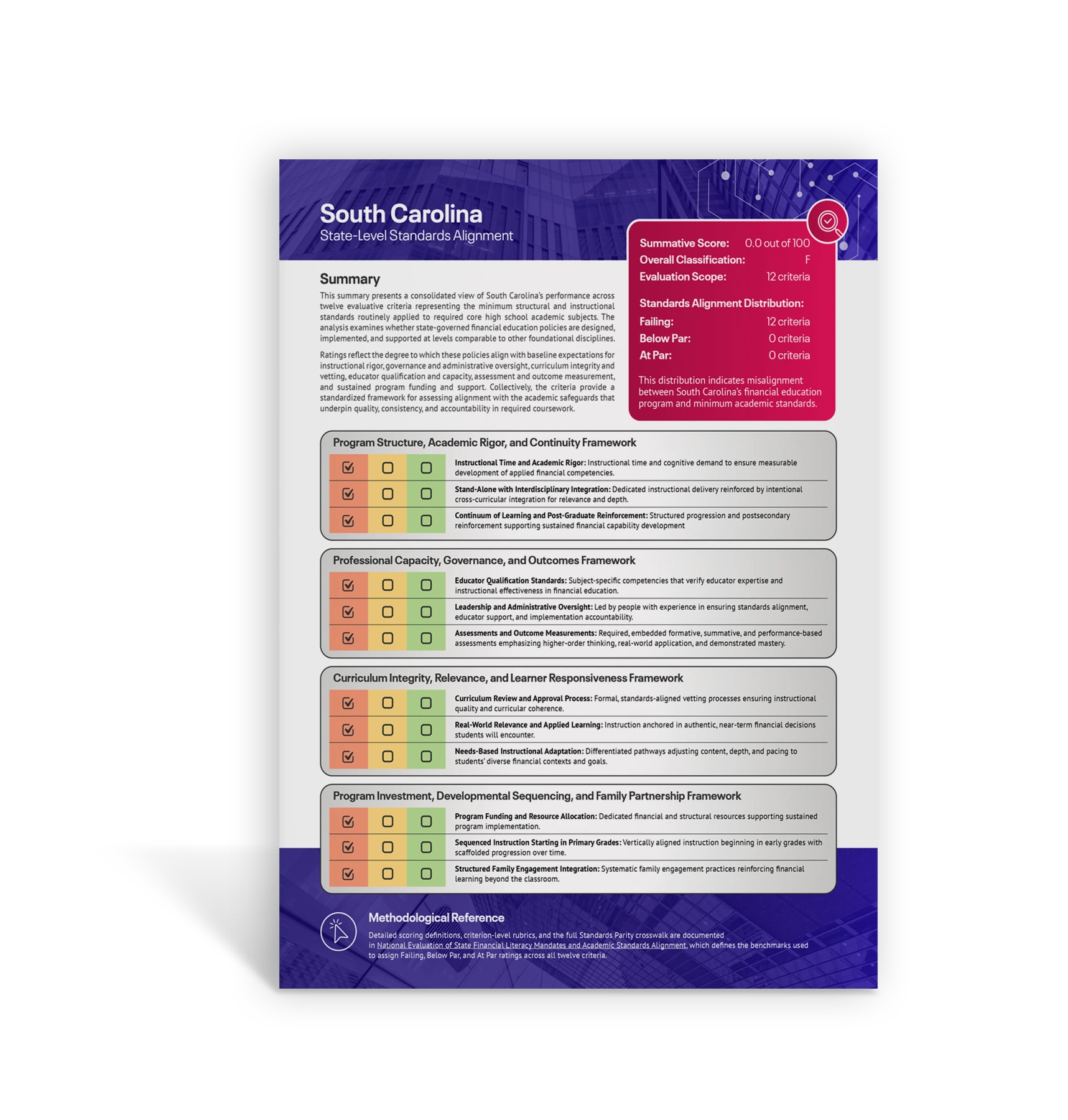
South Carolina Financial Education Standards Alignment: A State-Level Policy Assessment

Research from the National Financial Educators Council (NFEC) is designed to establish an objective foundation for improving financial literacy expectations across the country. Their analysis applies a consistent 12-criterion framework to determine alignment of financial education with standards for other core subjects, state-by-state. In South Carolina, the results point to a clear and pressing opening for policymakers, educators, and other stakeholders to reinforce both the state’s financial education requirements and the systems that support them. Strengthening these areas would help ensure that learners gain the essential financial knowledge and practical skills needed to make informed choices and build long‑term economic stability.

The South Carolina Financial Education Standards Alignment analysis paints an urgent picture. The state received a summative alignment score of 0.0 out of 100, earning an overall classification of “Failing.” All 12 evaluated criteria fell into the failing range, with none meeting or even approaching acceptable levels for below or at par. Such results signal a substantial disconnect between South Carolina’s current standards and widely recognized best practices in financial education. The findings point to potential weaknesses in curriculum structure, implementation strategies, or policy support that may be limiting the effectiveness of financial literacy instruction statewide.

South Carolina Financial Education Assessment

SCFEC’s Advocacy Focus in South Carolina

SCFEC works to ensure that financial education is treated as a core academic subject rather than optional enrichment. Our advocacy is organized to advance priorities that align South Carolina’s policy environment with established academic expectations.
Research & Policy Guidance

SCFEC promotes financial education policies aligned with core academic standards, emphasizing clear outcomes, educator preparedness, and accountability. Grounded in national research, SCFEC works with educators, community leaders, and policymakers to identify gaps, evaluate legislation, and support scalable, standards-aligned implementation.

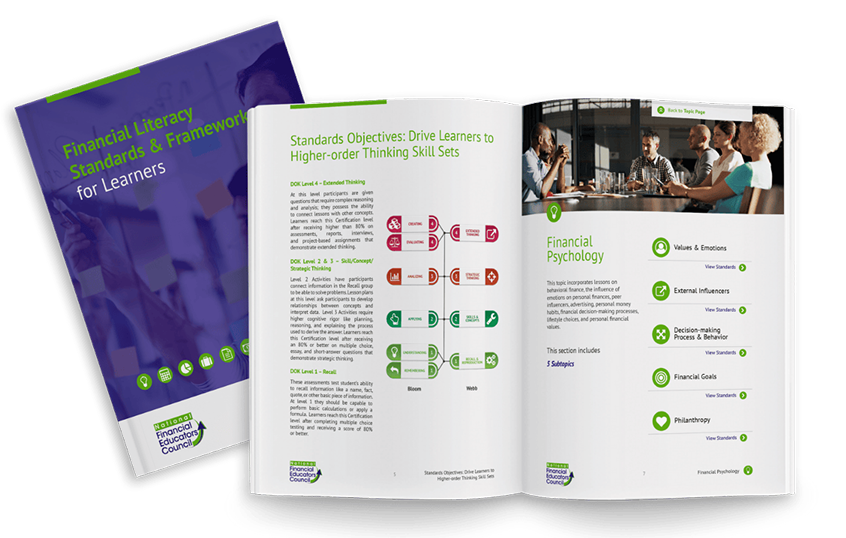
Standards for Financial Educators and Learners

SCFEC supports the adoption of comprehensive learner outcome standards and educator competency frameworks to strengthen instructional quality statewide. By providing clear benchmarks for what students should know and be able to do – and what educators must demonstrate to teach effectively – SCFEC helps establish consistent expectations that support long-term financial capability development.

Closing Statement

South Carolina’s students deserve more than exposure to financial concepts; they deserve real preparation for the financial decisions that shape adulthood. These findings reveal a clear opportunity to strengthen financial education by aligning it with the rigor and accountability applied to other core subjects.

By advancing standards-based reform and investing in quality implementation, South Carolina can ensure that every student graduates financially prepared for life beyond high school. Meaningful progress requires collective action from educators, families, policymakers, and community leaders – working together to make financial education a foundational part of a future-ready education system.

National Financial Educators Council

South Carolina Financial Educators Council

South Carolina Department of Education – Standards

South Carolina College- and Career-Ready Standards for Mathematics

State chapters

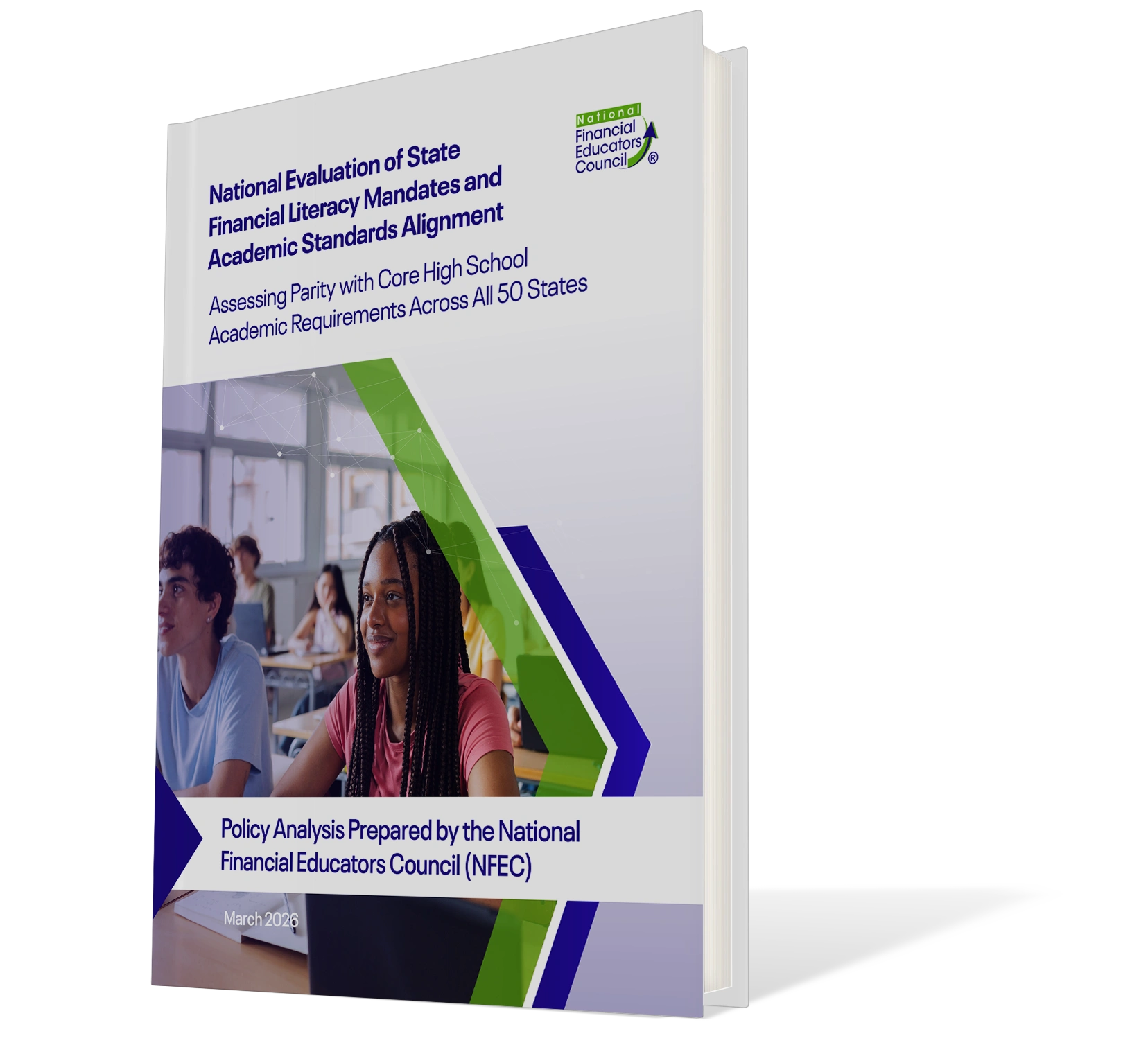
National Evaluation of State Financial Literacy Mandates and Academic Standards Alignment

State-Mandated Financial Literacy Standards: A Comprehensive National Review

Financial educator credentialing

Certified educator in personal finance

How to teach personal finance

Financial Literacy Standards in South Carolina

South Carolina does not currently have a statewide K-12 financial literacy graduation requirement codified in statute as of early 2026. While state standards include personal finance concepts within the South Carolina College- and Career-Ready Standards for Mathematics and Social Studies, there is no mandated standalone personal finance course required for high school graduation. Individual districts may offer personal finance electives or integrate standards into existing coursework at the local level. Source.

According to the South Carolina Department of Education, “Financial literacy instruction shall be incorporated within current courses throughout the state in accordance with The Financial Literacy Instruction Act (59-29-410).” The South Carolina Department of Education (SCDE) includes financial literacy topics in statewide content standards – including budgeting, saving, credit, and financial decision-making – often embedded across mathematics, economics, and social studies frameworks. However, implementation of those standards is left primarily to districts without uniform instructional expectations, required credit hours, or mastery assessments tied exclusively to financial literacy outcomes. Source.

Other Agencies’ Ratings of South Carolina Financial Literacy Standards

In other agencies’ view, the Palmetto State was doing fairly well in regard to setting standards for financial education in state schools. The Champlain College National Report Card on financial literacy instruction gave South Carolina a “B” grade in 2015. South Carolina received this grade due to the fact that the state requires high school students to take a half-year economics course – which has five benchmarks, one of which covers personal finance topics – in order to graduate.

The five economics standards include 25 indicators, and just three of those indicators focus on personal finance-related material. Based on that information, Champlain estimated that South Carolina students received approximately seven hours of money management teaching. In addition, the Palmetto State’s Department of Education provides online resources upon which teachers of economics and financial literacy may draw.

All school districts in South Carolina must implement the state’s standards for financial literacy education, included for grades K-12. The Council for Economic Education states that South Carolina does not require a high school personal finance course to be offered and/or taken, because personal finance is embedded in the economics curriculum.